
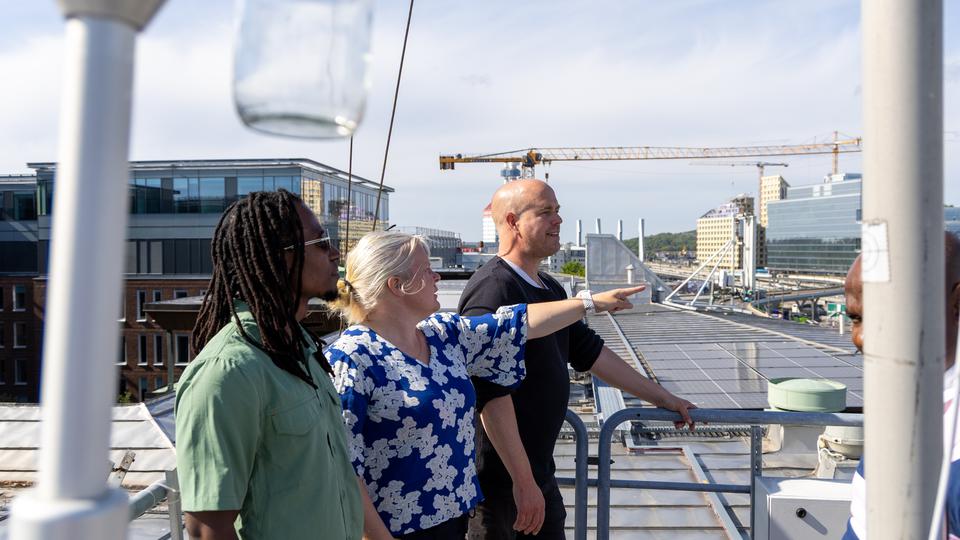
IVL's expert Ågot Watne shows air measurement system on roof of Nordstan shopping centre in Gothenburg.
A better living environment for children requires action and collaboration
An international research project shows that air quality is not just an environmental issue but also a matter of equal living conditions, and that a lack of data in many parts of the world hinders efforts to implement effective measures. Collaboration between Sweden, Kenya and South Africa will advance our knowledge of air pollution in children’s school environments, and hopefully be translated into concrete measures.
Effective air quality work requires both scientific evidence and strong governance. This project brings together researchers, government agencies and communities in three countries, creating valuable opportunities to translate knowledge into practical measures that can improve public health
, says Mandla Budha, a researcher at the University of Pretoria, South Africa.
IVL is taking part in a four-year Formas-funded research project in which Sweden, Kenya and South Africa are collaborating in order to address this. The focus is on generating knowledge about air pollution in children’s school environments and understanding how this knowledge can be translated into concrete measures that improve air quality. So, it is not only about measurements, but just as much about education, raising awareness, community engagement and policy development.
Collaboration for cleaner air and better living environments
The project team has taken measurements and organized school projects in Pretoria, and will expand its activities to Kenya this summer. By combining air quality measurement with educational initiatives and collaboration between schools, government agencies and researchers, the project aims to contribute to a better understanding of children’s exposure to air pollution. Furthermore, it builds the knowledge base for future measures and policy decisions.
Improving the air quality for children starts with understanding the pollutants they are exposed to where they live and learn. By combining measurement, education and international cooperation, we can generate knowledge that leads to healthier environments for future generations
, says Ågot Watne, air quality researcher at IVL Swedish Environmental Research Institute.
Greater understanding and knowledge through participation
Collaboration between countries is crucial to the project. When researchers and stakeholders from different backgrounds work together, different perspectives are explored, methods are developed and knowledge can be more quickly put into practice. This enables insights to be translated into action and, ultimately, improves children’s actual living environment. Also, the project links research to everyday life. In collaboration with schools and local government, pupils are engaged in understanding and mapping air quality in their own local environment. When children themselves are involved, both their knowledge and the potential for change are enhanced.
Air pollution remains one of the biggest environment-related health challenges globally. Through this collaboration, we are not only generating new knowledge about children’s exposure in Africa, we are also helping to raise awareness among young people of the importance of clean air
, says Mattias Hallquist of the University of Gothenburg.
None of the participating countries currently meets the WHO’s air quality guidelines, which underscores that this is not a local challenge but a common one. So on World Environment Day, the fifth of June, the focus is on what international cooperation can actually achieve: faster advances in knowledge, better information for decision-making, and greater opportunities to create healthy living environments for children.
For more information, contact:
Ågot Watne, agot.watne@ivl.se, tel. +46 (0)10-788 66 10